

Some knowledge points about hydraulic presses
Release time:
2021-07-01
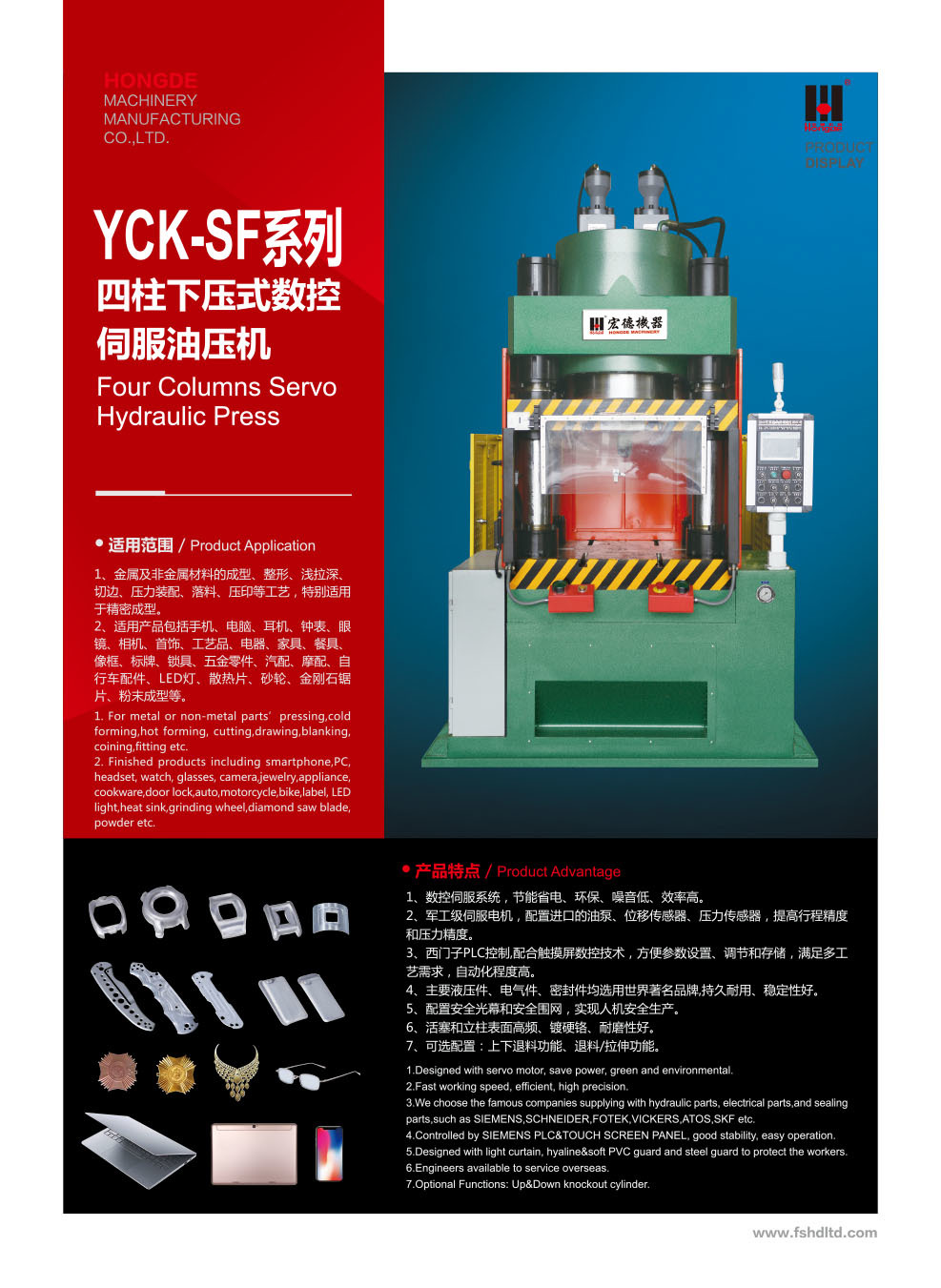
A hydraulic press uses oil to generate power, while a hydraulic machine can be driven by both oil and water, because water is also a liquid. Another type is an oil-gas mixture, called a pneumatic-hydraulic press, or a pressurized press. In fact, a hydraulic machine is a type of hydraulic press.
A hydraulic press is a type of hydraulic machine that uses special hydraulic oil as its working medium and a hydraulic pump as its power source. The pump's force causes the hydraulic oil to flow through the hydraulic lines into the cylinder/piston. Then, several sets of seals in the cylinder/piston work together. The seals in different positions are different, but they all play a sealing role to prevent hydraulic oil leakage.
Then, the hydraulic oil circulates in the tank through a one-way valve, and the cylinder/piston works cyclically to complete certain mechanical actions, becoming a productive machine.
Control valve of the hydraulic press: Controls the flow rate, direction, and pressure of the hydraulic oil, controls the working sequence of the hydraulic actuator, and protects the hydraulic circuit. In short, it controls and regulates the flow direction, pressure, and flow rate of the hydraulic medium, thereby controlling the movement direction, output force or torque, speed, and action sequence of the actuator, limiting and regulating the working pressure of the hydraulic system, and preventing overload.
Hydraulic presses and hydraulic machines share some common features:
1. Both have the same working principle. The working principle is hydraulic transmission, which is a transmission method that uses liquid pressure to transmit power and control.
2. The overall structure of both is roughly the same. They consist of three parts: the main machine (host), the power system, and the hydraulic control system.
3. They have the same functional characteristics. Both are widely used in the processing of auto parts, forming, trimming, and correcting various products in various industries, pressing and stamping of shoes, handbags, rubber, molds, shafts, sleeves, bending, stamping, and stretching of sheet metal parts, washing machines, motors, automotive motors, air conditioning motors, micromotors, servo motors, wheel manufacturing, shock absorbers, motorcycles, and machinery.
Foshan Hongde Machinery Manufacturing Co., Ltd.'s main products include precision punching machines, hydraulic presses, presses, Guangdong hydraulic machines, servo hydraulic presses, and punching machines. These products are now widely used in smart wearable devices such as mobile phones, tablet computers, and notebook computers, as well as automotive parts, home appliances and kitchenware, jewelry and crafts, and other industries and products.
Because of our focus, we are professional. Our founder has been dedicated to researching hydraulic presses since the 1980s. Our company inherits more than 30 years of hydraulic press manufacturing experience, technology, engineering and technical personnel, and skilled workers from state-owned enterprises; at the same time, we continuously improve, enhance, and perfect our products in line with industry development needs. Welcome customers to call for inquiries!
Recommended products
2023-05-12
What are the characteristics of a hydraulic press?
CNC hydraulic oil pumps generally use internal gear pumps, while traditional hydraulic presses generally use axial piston pumps. At the same flow rate and pressure, the noise of an internal gear pump is 5 dB to 10 dB lower than that of an axial piston pump. The motor of a CNC hydraulic press runs at rated speed during pressing and return, and its noise emission is 5 dB to 10 dB lower than that of a traditional hydraulic press. When the slider rapidly descends and is stationary, the servo motor speed is 0, so the CNC hydraulic press has essentially no noise emission.
2015-08-25
Application scope and system selection of small hydraulic presses
Suitable applications for small hydraulic presses include: 1. Punching various silicone and plastic buttons for mobile phones or remote controls, and cutting plastic products; 2. Cutting various protective films for mobile phones, digital cameras, and laptop LCD screens, as well as precision cutting and halving of various pressure-sensitive adhesives and trademarks; 3. Embossing, forming, etc., of various PV, PE, PC and other thin-film switches and panels; 4. Pressing and forming various flexible circuit lines for laptop keyboards, etc. Small hydraulic presses use original Taiwanese or Japanese parts for the hydraulic power system, resulting in fewer malfunctions, high efficiency, low noise, low horsepower requirements, easy maintenance, and convenient adjustment of output, speed, and stroke.
2014-04-29
Technology Daily (Reporter Shi Junbin, Correspondent Jiao Yue) Recently, a 19,500-ton free forging hydraulic press and a 300-ton/750-ton-meter full hydraulic forging manipulator, independently developed by China Heavy Industry Corporation, successfully completed their first hot load test run in Jiangyin, Jiangsu Province. This marks the completion of the world's largest tonnage free forging hydraulic press and the world's largest clamping force/clamping torque full hydraulic forging manipulator currently in operation, achieving a globally advanced level of overall equipment installation. The 19,500-ton free forging hydraulic press adopts a three-beam, four-column, three-cylinder, top-drive, press-insert, full pre-stressed frame structure. Both the upper and lower beams use pre-stressed composite beams. The maximum forging capacity can reach 4
Contact us
Address: No. 19, Science and Technology East Road, Songxia Industrial Park, Songgang, Nanhai District, Foshan City, Guangdong Province, China
Tel: 0086-0757-85203155
Mobile: 18033239126(Mr. Yang)
Fax: 0086-0757-85203166
Email: info@fs-hongdemachinery.com
Scan to follow
Xin Hongde Mobile Website
Quick Navigation
©2025 Foshan Xin Hongde Machinery Manufacturing Co., Ltd. All rights reserved