

Structure and functional characteristics of a hydraulic press
Release time:
2021-08-03
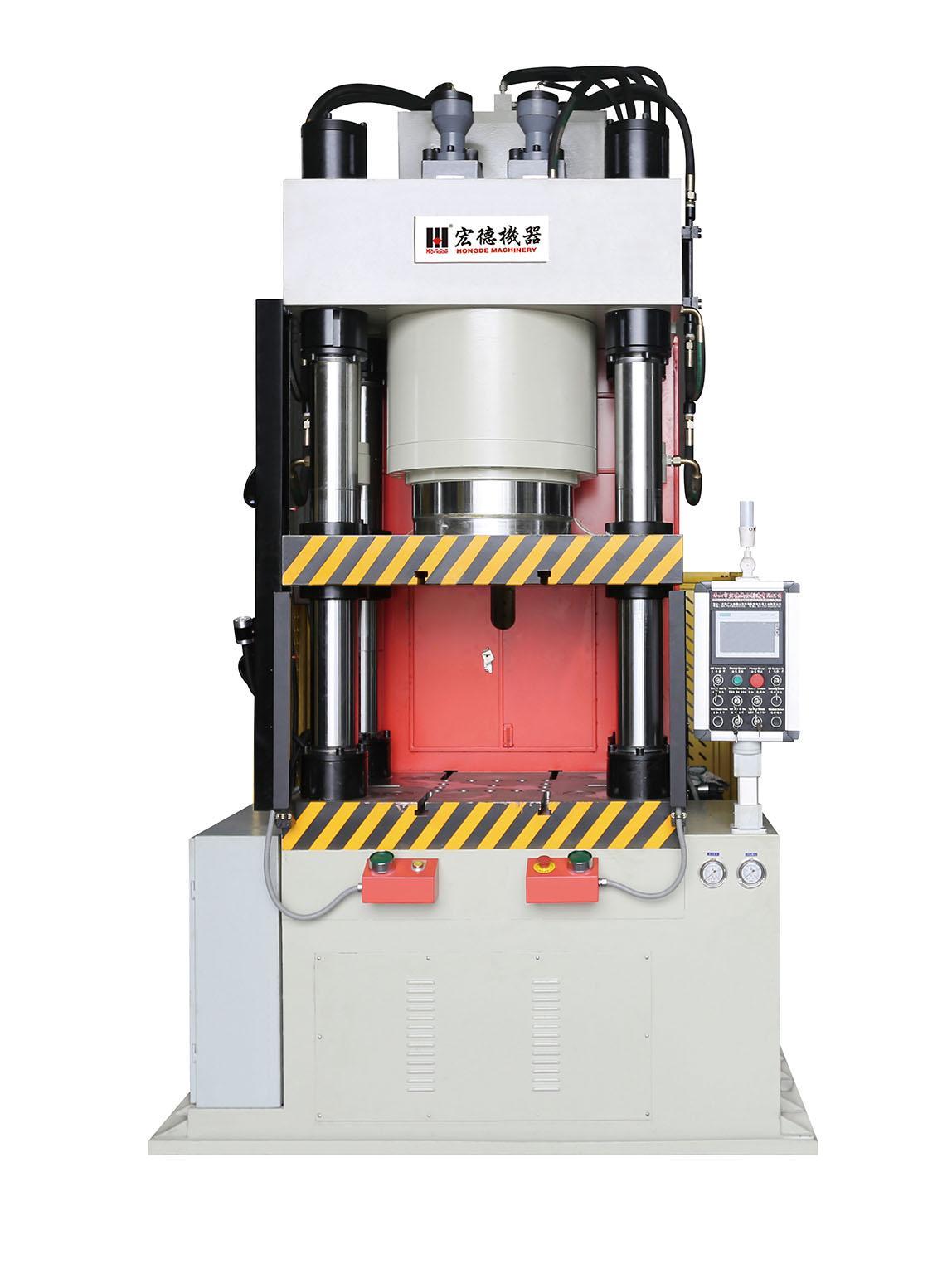
The hydraulic press adopts a vertical C-type structure design, which is rigid. All parts of the machine are installed inside the body, making it clean and beautiful in appearance. Compared with traditional hydraulic presses, this hydraulic press adds a pressure sensor. After microcomputer data acquisition and system processing, it is converted into a pressure value and displayed in digital form. When exceeding the limit, it will issue a sound and light alarm and a stop signal, achieving the purpose of automatic pressure control.
The hydraulic press overflow valve is a control valve, mainly used for constant pressure overflow, pressure stabilization, system unloading, and equipment safety maintenance. Constant pressure overflow effect: In the constant pressure pump energy-saving regulation system, the constant pressure pump provides a stable flow rate. When the system pressure increases, the flow demand will decrease. At this time, the hydraulic press overflow valve opens, allowing the excess flow to overflow back to the oil tank, ensuring the inlet pressure of the hydraulic press overflow valve, that is, the pump outlet pressure remains stable (the valve often opens with pressure fluctuations).
Hydraulic press overflow valves generally have two structures: 1. Direct-acting hydraulic press overflow valve 2. Pilot-operated hydraulic press overflow valve.
The main requirements for the overflow valve of a hydraulic press are: large pressure adjustment range, small pressure adjustment error, small pressure fluctuation, sensitive action, large overload capacity, and low noise.
Hydraulic presses with direct oil pump drive have the following characteristics:
1. The travel speed of the moving crossbeam of the hydraulic press depends on the pump's liquid supply and is not related to the deformation resistance of the workpiece during processing. If the pump's liquid supply is constant, the operating speed of the hydraulic press is a fixed value.
2. The power consumed by the pump is related to the deformation resistance of the workpiece being processed. The greater the operating deformation resistance, the greater the power consumed by the pump, and vice versa.
3. The uniform movement of the moving crossbeam and the change in the pump's supply force can be used as signals for the operating distributor to complete the automatic control of the hydraulic press.
4. Low investment, small footprint, and simple daily maintenance. The pump in the direct drive system is selected according to the larger operating speed and pressure of the hydraulic press, but when the hydraulic press is in the filling stroke, return stroke, auxiliary process, and short-term required working pressure, the pump is not fully utilized, especially for large-tonnage hydraulic presses, its utilization coefficient is very low. Therefore, hydraulic presses tend to use staged drive operation speed and pressure.
Recommended products
2023-05-12
What are the characteristics of a hydraulic press?
CNC hydraulic oil pumps generally use internal gear pumps, while traditional hydraulic presses generally use axial piston pumps. At the same flow rate and pressure, the noise of an internal gear pump is 5 dB to 10 dB lower than that of an axial piston pump. The motor of a CNC hydraulic press runs at rated speed during pressing and return, and its noise emission is 5 dB to 10 dB lower than that of a traditional hydraulic press. When the slider rapidly descends and is stationary, the servo motor speed is 0, so the CNC hydraulic press has essentially no noise emission.
2015-08-25
Application scope and system selection of small hydraulic presses
Suitable applications for small hydraulic presses include: 1. Punching various silicone and plastic buttons for mobile phones or remote controls, and cutting plastic products; 2. Cutting various protective films for mobile phones, digital cameras, and laptop LCD screens, as well as precision cutting and halving of various pressure-sensitive adhesives and trademarks; 3. Embossing, forming, etc., of various PV, PE, PC and other thin-film switches and panels; 4. Pressing and forming various flexible circuit lines for laptop keyboards, etc. Small hydraulic presses use original Taiwanese or Japanese parts for the hydraulic power system, resulting in fewer malfunctions, high efficiency, low noise, low horsepower requirements, easy maintenance, and convenient adjustment of output, speed, and stroke.
2014-04-29
Technology Daily (Reporter Shi Junbin, Correspondent Jiao Yue) Recently, a 19,500-ton free forging hydraulic press and a 300-ton/750-ton-meter full hydraulic forging manipulator, independently developed by China Heavy Industry Corporation, successfully completed their first hot load test run in Jiangyin, Jiangsu Province. This marks the completion of the world's largest tonnage free forging hydraulic press and the world's largest clamping force/clamping torque full hydraulic forging manipulator currently in operation, achieving a globally advanced level of overall equipment installation. The 19,500-ton free forging hydraulic press adopts a three-beam, four-column, three-cylinder, top-drive, press-insert, full pre-stressed frame structure. Both the upper and lower beams use pre-stressed composite beams. The maximum forging capacity can reach 4
Contact us
Address: No. 19, Science and Technology East Road, Songxia Industrial Park, Songgang, Nanhai District, Foshan City, Guangdong Province, China
Tel: 0086-0757-85203155
Mobile: 18033239126(Mr. Yang)
Fax: 0086-0757-85203166
Email: info@fs-hongdemachinery.com
Scan to follow
Xin Hongde Mobile Website
Quick Navigation
©2025 Foshan Xin Hongde Machinery Manufacturing Co., Ltd. All rights reserved