

Technical guidance and product introduction for mechanical hot forging machines
Release time:
2022-01-10
Mechanical hot forging machinery technology guidance product introduction
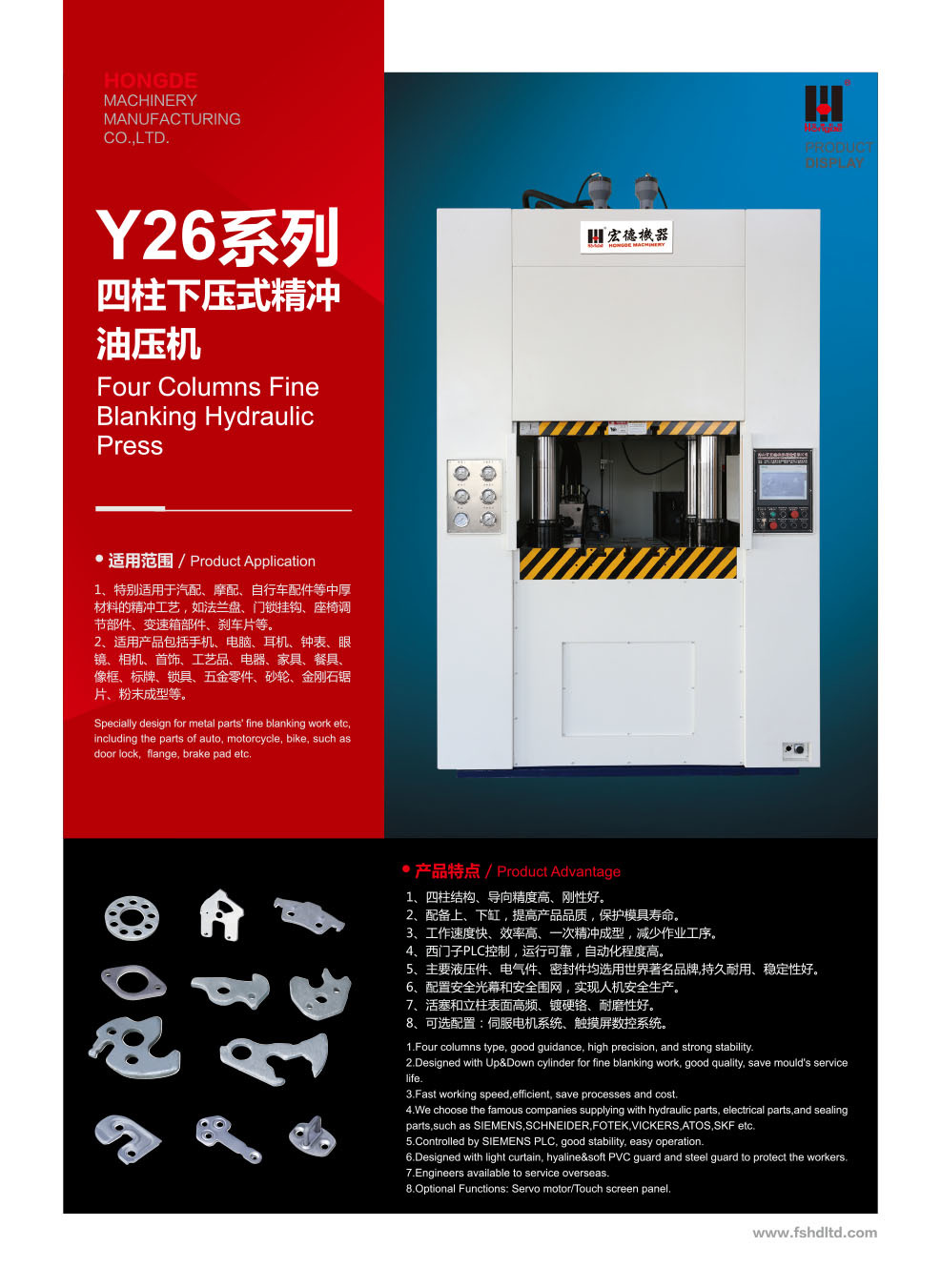
Performance of forging equipment
The forging equipment of a screw press is essentially more like a hammer, belonging to a machine with limited energy. Forging demands are high; generally, it can reach twice the rated load. The impact speed of a screw press is approximately 0.7m/s, several to dozens of times that of hydraulic presses and mechanical presses. Caution should be exercised when using low-temperature alloys and powder metallurgy materials sensitive to deformation speed on die-making equipment.
Mechanical hot forging machines are relatively traditional forging equipment, with higher free speed, lower forging speed, and more fluctuating practice. It is also suitable for completing a process in one stroke. Hammers for low-temperature alloys and titanium forgings that are sensitive to deformation speed and difficult to melt, high-speed and multi-stroke are mainly used for forging steel and stainless steel forgings, and also for titanium forgings and the speed of spiral hot forging machines.
Why are hot forging machines so important?
Hot forging machines are very important equipment in the machinery manufacturing industry. As everyone knows, for metals that cannot be shaped, they can be shaped into a certain shape according to forging machinery. Therefore, forging equipment is obviously needed by the machinery manufacturing industry. Forging equipment manufacturers are generally called metal forming CNC lathes because forging machinery is mainly used for metal forming. The name of the forging machine indicates that metal modeling needs to release enough force to the metal so that it can be formed after deformation. Therefore, one of the main characteristics of a forging machine is its great force.
When using forging machinery equipment, we must pay attention to the standardization of actual operation. Because the commercial force of forging machinery equipment is very large. Although the equipment itself contains various protective measures, once an accident occurs, the adverse effects are unpredictable, and standard actual operation can improve the service life of forging machinery equipment to a certain extent, increase its working time, and save certain economic development costs for the company. The body of the forging machinery equipment is the core position of the work. During operation, the gas of the forging equipment must withstand all forces, change and fix the shape of the metal, so the compressive strength and bending stiffness of the gas will immediately damage the accuracy of metal forming. In addition, due to long-term internal force, the compressive strength of the gas will also endanger the service life of the equipment.
Understanding energy conservation and emission reduction of hot forging machines from different perspectives.
From the overall situation of the hot forging machine industry, the overall situation of energy conservation and emission reduction is not optimistic. Because there are many low-level equipment and serious repeated construction, which affects the use of hot forging machines. From the current situation, the energy conservation and emission reduction work in the forging machinery industry is still a long way off. To achieve energy conservation and emission reduction, the following points need to be done. Implement energy conservation and emission reduction in the forging machinery industry.
Energy conservation and emission reduction in the hot forging machine industry should be understood from two aspects. One is direct energy saving. The other is indirect energy saving. Direct energy saving mainly reduces equipment energy consumption and improves equipment utilization. Indirect energy saving is a kind of scrap, which can reduce front-end resource consumption and subsequent processing consumption, thereby achieving energy saving.
The overall situation of energy conservation and emission reduction in the short-term industry is not optimistic. Because there are many low-level equipment and serious repeated construction, which affects the use of forging machines.
Recommended products
2023-05-12
What are the characteristics of a hydraulic press?
CNC hydraulic oil pumps generally use internal gear pumps, while traditional hydraulic presses generally use axial piston pumps. At the same flow rate and pressure, the noise of an internal gear pump is 5 dB to 10 dB lower than that of an axial piston pump. The motor of a CNC hydraulic press runs at rated speed during pressing and return, and its noise emission is 5 dB to 10 dB lower than that of a traditional hydraulic press. When the slider rapidly descends and is stationary, the servo motor speed is 0, so the CNC hydraulic press has essentially no noise emission.
2015-08-25
Application scope and system selection of small hydraulic presses
Suitable applications for small hydraulic presses include: 1. Punching various silicone and plastic buttons for mobile phones or remote controls, and cutting plastic products; 2. Cutting various protective films for mobile phones, digital cameras, and laptop LCD screens, as well as precision cutting and halving of various pressure-sensitive adhesives and trademarks; 3. Embossing, forming, etc., of various PV, PE, PC and other thin-film switches and panels; 4. Pressing and forming various flexible circuit lines for laptop keyboards, etc. Small hydraulic presses use original Taiwanese or Japanese parts for the hydraulic power system, resulting in fewer malfunctions, high efficiency, low noise, low horsepower requirements, easy maintenance, and convenient adjustment of output, speed, and stroke.
2014-04-29
Technology Daily (Reporter Shi Junbin, Correspondent Jiao Yue) Recently, a 19,500-ton free forging hydraulic press and a 300-ton/750-ton-meter full hydraulic forging manipulator, independently developed by China Heavy Industry Corporation, successfully completed their first hot load test run in Jiangyin, Jiangsu Province. This marks the completion of the world's largest tonnage free forging hydraulic press and the world's largest clamping force/clamping torque full hydraulic forging manipulator currently in operation, achieving a globally advanced level of overall equipment installation. The 19,500-ton free forging hydraulic press adopts a three-beam, four-column, three-cylinder, top-drive, press-insert, full pre-stressed frame structure. Both the upper and lower beams use pre-stressed composite beams. The maximum forging capacity can reach 4
Contact us
Address: No. 19, Science and Technology East Road, Songxia Industrial Park, Songgang, Nanhai District, Foshan City, Guangdong Province, China
Tel: 0086-0757-85203155
Mobile: 18033239126(Mr. Yang)
Fax: 0086-0757-85203166
Email: info@fs-hongdemachinery.com
Scan to follow
Xin Hongde Mobile Website
Quick Navigation
©2025 Foshan Xin Hongde Machinery Manufacturing Co., Ltd. All rights reserved