

Comprehensive explanation of hot forging machines
Release time:
2022-01-24
The forging process carried out above the recrystallization temperature of metal is called hot forging. Hot plasticity, also known as hot die forging, uses hot die forging machines, also known as hot die forging hydraulic presses, as its processing equipment. Hot forging machines are forging equipment widely used in the processing of hot forged parts in industries such as automobiles, trains, ships, aviation, mining machinery, petroleum machinery, and hardware tools.
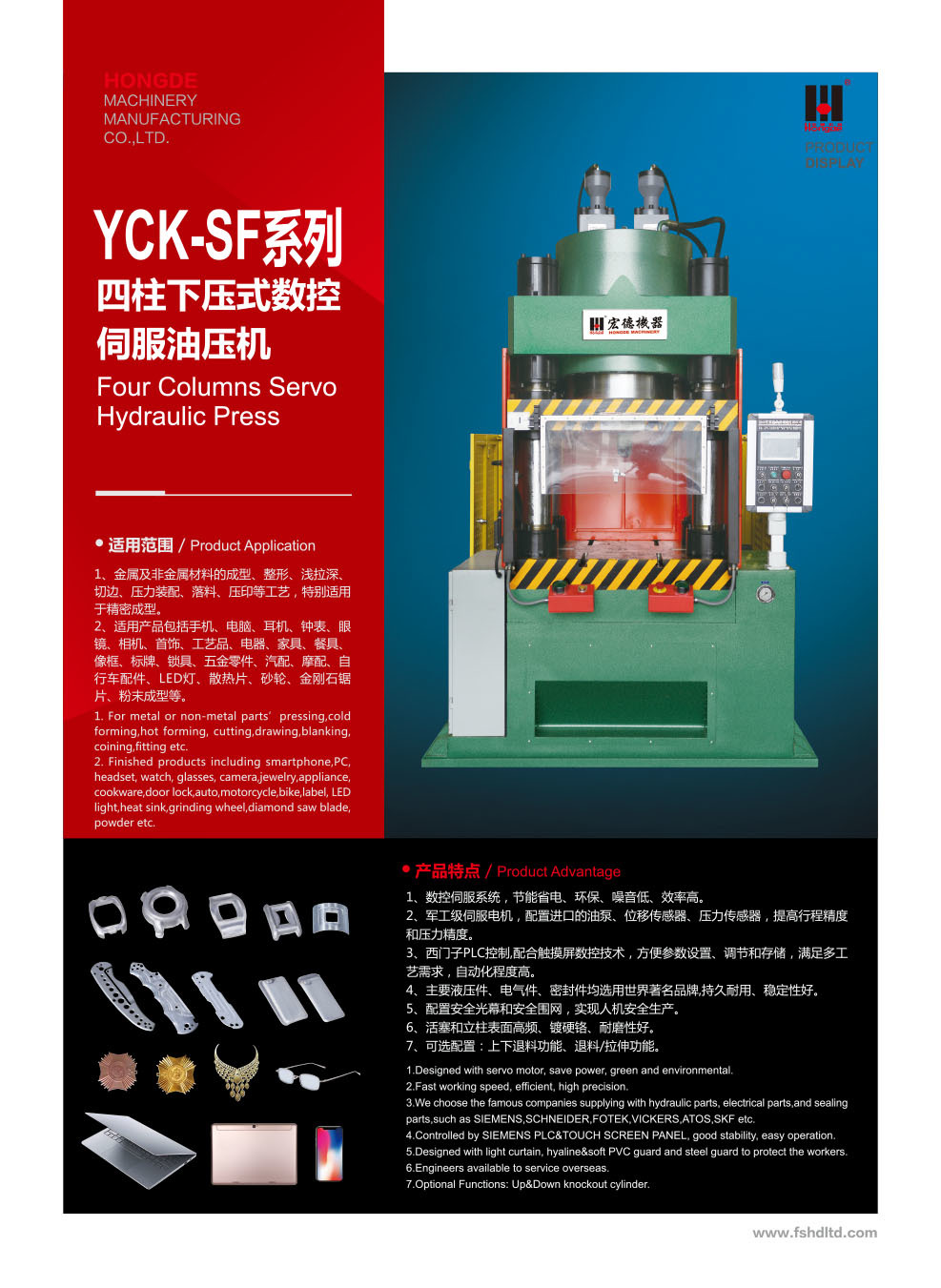
Compared with ordinary hot forging presses, hot forging machines have advantages such as high production efficiency, simple operation, convenient maintenance, and suitability for automatic forging production lines. Its characteristics are fast impact speed, short mold hot contact time, long mold life, high stamping precision, and improved forging quality while improving material utilization.
Hot forging machines are forging equipment that can complete various free forging processes and are one of the widely used equipment in the forging industry. There are forging hydraulic presses with specifications such as 800T, 1600T, 2000T, 2500T, 3150T, 4000T, and 5000T. The hydraulic system has automatic protection devices such as multi-level overload protection, oil temperature alarm, and oil level alarm protection. The electrical system adopts mature PLC control to ensure the safety of equipment and operators. The pressure working cylinder simultaneously supplies a large-capacity flow charging valve and oil tank to achieve rapid charging, oil replenishment, and oil recovery during rising, saving auxiliary time for short seeking and improving forging efficiency. A stable cooling circulation system is installed on the equipment to stably control the temperature rise, ensuring the safe and stable operation of the system.
What is the difference between a hot forging machine and an ordinary hydraulic press?
Hot forging machines and ordinary hydraulic presses are both types of hydraulic presses, but their functions and uses are different. Hot forging hydraulic presses mainly produce forged workpieces, while ordinary hydraulic presses complete basic forging processes for certain production. Let's discuss the differences between hot forging hydraulic presses and ordinary hydraulic presses in detail below.
Differences in pressure and power
Hot-formed workpieces need to undergo multiple forging processes to take shape, so the oil cylinder speed is fast, the frequency is high, and the stroke is adjustable, which helps improve productivity. Ordinary machines have very high pressure and power.
An ordinary hydraulic press is a press equipment capable of completing basic forging processes. The pressure and power of the machine depend on the pressing requirements of the press components. It is much smaller than that of a hot forging machine.
Difference in machine price
In terms of structure and function, the manufacturing cost of a hot forging machine is much higher than that of an ordinary hydraulic press, so the price of a hot forging hydraulic press is much higher than that of an ordinary hydraulic press. This is because the machine's design structure and internal components are completely different.
When installing a 1200-ton hot forging machine, pay special attention to the following four points:
1. Check the accessories and damaged parts of the 1200-ton hot forming press, and place the hot press in a dry place for 3-4 days to remove moisture from the motor and electrical equipment. If necessary, use instruments to measure whether the electrical insulation of the hot press is good.
2. Install according to the drawings. After the foundation is hardened, firmly install the hot forging press, use a level to check the level of the press working surface, and note that the deviation should not exceed 0.3 mm per 1000 mm length.
3. Compensate for the tilt height of the hot forming press, install anchor bolts after compensation, then pour concrete into the square holes, and carry out construction after the concrete is completely hardened.
4. After installation, properly clean the 1200-ton hot forging machine. When cleaning, be careful not to damage the surface of the hot forging press. Do not use metal or sandpaper to forcefully wipe during cleaning.
Recommended products
2023-05-12
What are the characteristics of a hydraulic press?
CNC hydraulic oil pumps generally use internal gear pumps, while traditional hydraulic presses generally use axial piston pumps. At the same flow rate and pressure, the noise of an internal gear pump is 5 dB to 10 dB lower than that of an axial piston pump. The motor of a CNC hydraulic press runs at rated speed during pressing and return, and its noise emission is 5 dB to 10 dB lower than that of a traditional hydraulic press. When the slider rapidly descends and is stationary, the servo motor speed is 0, so the CNC hydraulic press has essentially no noise emission.
2015-08-25
Application scope and system selection of small hydraulic presses
Suitable applications for small hydraulic presses include: 1. Punching various silicone and plastic buttons for mobile phones or remote controls, and cutting plastic products; 2. Cutting various protective films for mobile phones, digital cameras, and laptop LCD screens, as well as precision cutting and halving of various pressure-sensitive adhesives and trademarks; 3. Embossing, forming, etc., of various PV, PE, PC and other thin-film switches and panels; 4. Pressing and forming various flexible circuit lines for laptop keyboards, etc. Small hydraulic presses use original Taiwanese or Japanese parts for the hydraulic power system, resulting in fewer malfunctions, high efficiency, low noise, low horsepower requirements, easy maintenance, and convenient adjustment of output, speed, and stroke.
2014-04-29
Technology Daily (Reporter Shi Junbin, Correspondent Jiao Yue) Recently, a 19,500-ton free forging hydraulic press and a 300-ton/750-ton-meter full hydraulic forging manipulator, independently developed by China Heavy Industry Corporation, successfully completed their first hot load test run in Jiangyin, Jiangsu Province. This marks the completion of the world's largest tonnage free forging hydraulic press and the world's largest clamping force/clamping torque full hydraulic forging manipulator currently in operation, achieving a globally advanced level of overall equipment installation. The 19,500-ton free forging hydraulic press adopts a three-beam, four-column, three-cylinder, top-drive, press-insert, full pre-stressed frame structure. Both the upper and lower beams use pre-stressed composite beams. The maximum forging capacity can reach 4
Contact us
Address: No. 19, Science and Technology East Road, Songxia Industrial Park, Songgang, Nanhai District, Foshan City, Guangdong Province, China
Tel: 0086-0757-85203155
Mobile: 18033239126(Mr. Yang)
Fax: 0086-0757-85203166
Email: info@fs-hongdemachinery.com
Scan to follow
Xin Hongde Mobile Website
Quick Navigation
©2025 Foshan Xin Hongde Machinery Manufacturing Co., Ltd. All rights reserved